
Inter Partes Review Under the AIA

Background

Inter Partes Review is a trial before the PTAB subject to the procedures set forth in subpart A. Proposed 37 CFR §42.100(a).  The Inter Partes Review should be concluded within one year, but this can be extended up to six months, by the Chief Judge of the PTAB.  Proposed 37 CFR §42.100(c).

Any person other than the patent owner may petition for Inter Partes Review, provided that the Petition has not previously challenged the patent in a civil action (Proposed 37 CFR §42.101(a)); the Petition is filed less than one year from when the petitioner was sued for infringing the patent (Proposed 37 CFR §42.101(b)); and the petitioner is not otherwise estopped (Proposed 37 CFR §42.101(c)).  (The regulation is worded to permit concurrent or subsequent civil action).

A petition for an Inter Partes Review of a patent must be filed more than nine months after the date of the grant of an original or reissue patent. (Proposed 37 CFR §42.102(a)(1)), and after the termination of any Inter Partes Review proceedings (Proposed 37 CFR §42.102(a)(2)).  For at least the first four years, the Director may impose limits on the number of Inter Partes Reviews.  (Proposed 37 CFR §42.102(b)).

Initiation

The petition for Inter Partes Review must contain:

A certification that the patent for which review is sought is available for Inter Partes Review (any patent in force on or after September 16, 2012) and that the petitioner is not barred or estopped from requesting Inter Partes Review of the patent. (Proposed 37 CFR §41.204(a)).

A statement of the relief requested, identifying

  • the claim (Proposed 37 CFR §42.104(b)(1)).
  • the statutory grounds for the challenge, which is restricted to 35 U.S.C. §§102,103.  (Proposed 37 CFR §42.104(b)(2)).
  • a statement of how the claim is to be construed.  (Proposed 37 CFR §42.104(b)(3)).
  • a statement of how the construed claim is unpatentable under the asserted statutory grounds.  (Proposed 37 CFR §42.104(b)(4)).
  • The exhibit number of the supporting evidence, and a statement of the relevance of the evidence to the challenge raised identifying the specific portions of the evidence that support the challenge. (Proposed 37 CFR §42.104(b)(5)).

The petition must specify where each element of the claim is found in the prior art. (Proposed 37 CFR §42.104(b)(4)).

The petitioner may correct clerical or typographical errors in the petition by motion to the PTAB.  (Proposed 37 CFR §42.104(c)).

The petition and fee (proposed 37 CFR §42.103) must be filed with the PTO, and a copy of the petition and exhibits served upon the patent owner (proposed 37 CFR §42.105)).  (Proposed 37 CFR §42.106)).The proposed fees are:

 1 to 20 claims: $27,200

21 to 30 claims: $34,000

31 to 40 claims: $40,800

41 to 50 claims: $54,400

51 to 60 claims: $68,000

$27,200 for each additional group of ten claims

(Proposed 37 CFR §42.15(a)(1-6)).  If the Petition is incomplete it will not be assigned a filing date, and the petitioner has until the earlier of one month or the nine months from issuance to correct the deficiency.  (Proposed 37 CFR §42.106(b)). This response must comply with proposed Rule 42.24.

Patentee’s Response to Petition

The patentee has the option to file a preliminary response to explain why no Inter Partes Review should be instituted.  (Proposed 37 CFR §42.107(a)). This response must comply with proposed 37 CFR §42.24, and it cannot include new testimonial evidence (proposed 37 CFR §42.107(b)) nor can the patentee amend the claims (proposed 37 CFR §42.107(d)), but the patentee can disclaim patent claims (proposed 37 CFR §42.107(e)).  The response is due two months from the date of the petition, but the patentee can speed up the process by filing sooner, or waiving the right to a response.  (Proposed 37 CFR §42.107(b)).

Instituting Inter Partes Review

If the PTAB decides that the petition would, if unrebutted, demonstrate that it is more likely than not that at least one of the challenged claims is unpatentable, then the PTAB should grant Inter Partes Review. (Proposed 37 CFR §42.108(c)).  The PTAB may authorize the review to proceed on all or some of the challenged claims and on all or some of the grounds of unpatentability asserted for each claim.  (Proposed 37 CFR §42.108(a)).  Similarly, the PTAB can deny some or all grounds for unpatentability for some or all of the challenged claims. (Proposed 37 CFR §42.108(b)).

Conduct of Inter Partes Review

Once the Inter Partes Review is instituted, the patentee may file a response to the petition addressing any ground for unpatentability not already denied (Proposed 37 CFR §42.120(a)) by the date provided by the PTAB, or if none within two months from the date Inter Partes Review is instituted.  After conferring with the PTAB, the patentee may make one motion to amend the claims.  (Proposed 37 CFR §42.121(a)).  This motion must identify the support in the original disclosure of the patent for each claim that is added or amended (proposed 37 CFR §42.121(b)(1)) and the support in an earlier filed disclosure for each claim for which benefit of the earlier filing date is sought (Proposed 37 CFR §42.121(b)(2)).  The patentee is cannot make amendments that do not respond to a ground of unpatentability involved in the proceeding (proposed 37 CFR §42.121(c)(1)), or which enlarge the scope of the claims or introduce new matter (proposed 37 CFR §42.121(c)(2).

During the preceding the claims are given their broadest reasonable construction in light of the specification.  (Proposed 37 CFR §42.100(b)).  Within one month from when a trial has been instituted, a petitioner may request authorization to file a motion identifying supplemental information relevant to a ground for which the trial has been instituted. (Proposed 37 CFR §42.123.

Derivation Proceedings under the AIA

Background

The America Invents Act shifts the United States from a first-to-invent to a first-to-file patent system.  This eliminates the need the determine the first inventor, and thus the AIA eliminates patent interferences, and instead provides a new procedure – a Derivation Proceeding – for determining whether an earlier filed application was derived from the inventor of a later filed application.

New 35 U.S.C. §135(a) entitled “Derivation proceedings” provides:

An applicant for patent may file a petition to institute a derivation proceeding in the Office. The petition shall set forth with particularity the basis for finding that an inventor named in an earlier application derived the claimed invention from an inventor named in the petitioner’s application and, without authorization, the earlier application claiming such invention was filed. Any such petition may be filed only within the 1–year period beginning on the date of the first publication of a claim to an invention that is the same or substantially the same as the earlier application’s claim to the invention, shall be made under oath, and shall be supported by substantial evidence. Whenever the Director determines that a petition filed under this subsection demonstrates that the standards for instituting a derivation proceeding are met, the Director may institute a derivation proceeding. The determination by the Director whether to institute a derivation proceeding shall be final and nonappealable.

The USPTO estimates that there will only be about fifty Derivation Proceedings a year.

Timing

New §135(a) requires that the Derivation Proceeding be initiated within one year “of the first publication of a claim to an invention that is the same or substantially the same as the earlier application’s claim to the invention.”  This is echoed in proposed 37 CFR §42.403, and is similar to the language in old §135(b)(2) pertaining to interferences, but it leaves some inexplicable gaps.  For example what happens if the one year from publication passes before offending claims are presented in the earlier application?


Initiating

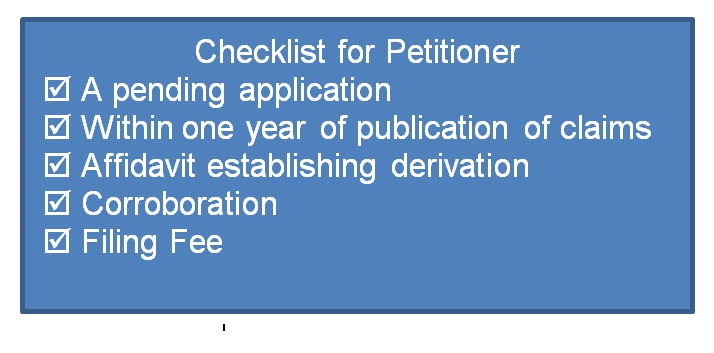
A Derivation Proceeding can only be initiated by a patent applicant (proposed 37 CFR §42.402) which includes a reissue applicant (proposed 37 CFR §42.401).  The petition must:

  • Show that the petitioner has a pending application, and the petition is being timely filed.  Proposed 37 CFR §42.405(a)(1).   
  • Show that the petition’s application contains at least one claim that is substantially the same as the respondent’s claimed invention (proposed 37 CFR §42.405(a)(2)(i)) that is not patentably distinct from the invention disclosed to the respondent (proposed 37 CFR §42.405(a)(2)(ii).
  • Provide sufficient information to identify the application or patent for which the petitioner seeks a derivation proceeding.  Proposed 37 CFR §42.405(b)(1).   
  • Demonstrate that an invention was derived from an inventor named in the petitioner’s application and that the earlier application was filed without authorization.  Proposed 37 CFR §42.405(b)(2).   
  • Show why the respondent’s claimed invention is not patentably distinct from the invention disclosed to the respondent.  Proposed 37 CFR §42.405(b)(3)(i).
  • Identify how the claim is to be construed. Proposed 37 CFR §42.405(b)(3)(ii).

Overall, the petition must be supported by substantial evidence, which at a minimum would include an Affidavit addressing communication of the derived invention to the respondent, and respondent’s lack of authorization to file.  Proposed 37 CFR §42.405(c).  The showing must be corroborated.  Proposed 37 CFR §42.405(c). 

The petition must be accompanied by the derivation fee, currently expected to be $400 (proposed 37 CFR §42.404) and must be served upon the respondent (proposed 37 CFR §42.406).  Proposed 37 CFR §42.407(a). 

If the petition is defective, the petitioner must correct the defects  by the earlier of one month from notice of the incomplete request, or the expiration of the statutory deadline in which to file a petition for derivation.  Proposed 37 CFR §42.407(b).

The determination by the Director whether to institute a derivation proceeding is final and nonappealable.  New 35 U.S.C. §135(a).

Determination

The Derivation Proceeding is decided by the Patent Trial and Appeal Board (PTAB) (new 35 U.S.C. §135(a); proposed 37 CFR §42.408), unless the parties opt for arbitration (new 35 U.S.C. §135(f); 37 CFR §42.410), which is dispositive as to the parties.  The proceeding is a trial governed by the Subpart A regulations.  37 CFR §42.400(a).  The final decision of the PTAB, if adverse to claims in a pending application constitutes a final refusal of those claims, and if adverse to claims in an issued patent, constitutes cancellation of those claims (unless appealed).  New 35 U.S.C. §135(d).  The PTAB also as the authority to correct the naming of the inventor in any application or patent at issue.  New 35 U.S.C. §135(d).  The PTAB decisions are generally public record.  37 CFR §42.412.

The PTAB can defer action on a derivation proceeding until three months after a patent issues on the earlier application, or stay the derivation proceeding until the termination of a Reexamination, Inter Partes Review, or Post Grant Review. New 35 U.S.C. §135(d).  The PTAB can also decline to institute a Derivation Proceeding if where the patents/applications involved are commonly owned.  37 CFR §42.411.

Settlement

The parties to a Derivation Proceeding can terminate it by filing a written statement reflecting the agreement of the parties as to the correct inventors of the claimed invention in dispute, and the PTAB will act accordingly unless the agreement is inconsistent with the evidence of record.  New 35 U.S.C. §135(e); proposed 37 CFR §42.409.  The settlement agreement must be filed with the Director, but upon request will be treated as business confidential information, and only made available only to Government agencies on written request, or to any person on a showing of good cause. New 35 U.S.C. §135(e).

Recommendations

Inventors who thought that the AIA would dispense with the need for inventor notebooks are disappointed.  The date of invention, and in particular whether it is prior to or subsequent to a third party disclosure, is the central issue in a Derivation proceeding, and the inventor will want proof of these events.  Moreover, it is more important than ever to document what disclosures are made and to whom, in order to prove derivation.  Not surprisingly under a first-to-file regime, getting the earliest filing date possible is the best plan, and getting a filing date before any outside disclosures eliminates the possibility of derivation.

Derivation proceedings are more likely to result from attempted collaboration, than outright theft.  After the inventor of A and the inventor of B have some preliminary talks, and the inventor of A begins to think about A + B, while the inventor of B begins to think about B + A, the difference between building on the prior art and derivation begins to blur.  An agreement prior to the discussions could avoid at least some these difficulties.

To avoid derivation proceedings, then, one should try to limit third party disclosures until after at least a provisional application has been filed, and address the ownership issues in the confidentiality agreement covering the disclosure.

Welcome to HDP’s AIA Blog!

The HDP AIA Blog is a convenient way to keep up with developments relating to the America Invents Act.

For the time being this is a purely internal blog, but we will considering making the blog public.  We are counting on everyone to participate either by submitting posts or participating in discussions.  Please contribute your thoughts about AIA implementation, and any useful information that you create or come across.

Ten Strategies for Exploiting Patent Reform

1. File Early and File Often.

Get a prompt early filing date for new developments with a provisional patent application.  Update and re-file the provisional application as improvements are made.  Get the earliest possible filing date for each development.  Until there is clarity, do not trust the one year grace period where you do not have to.

2.  Consider a Simultaneous Public Disclosure With Your Patent Filings.

Simultaneous publication with your patent filings creates an early prior art date in case you elect not to pursue your provisional patent application.  (A provisional application that is never converted or refilled as a utility patent application is not prior art).

3.  Control Which Law Applies To Your Application.

In most cases the old patent law is more advantageous to applications, so applicants will want to file all new applications and new continuation in part (C-I-P) applications before March 16, 2013.  After March 16, 2013, applicants may want to segregate continuation applications from CIP applications that might be covered by the new law.

4.  File Parallel Applications Under Both the Old And New Laws?

To the extent that an applicant perceives a benefit to being treated under the new law, that applicant may want to hedge its bets by filing an application before March 16, 2013, and a second C-I-P application with a slightly supplemented disclosure after March 16, 2013.  The applicant can then have the new law apply simply by adding a claim to the supplemented disclosure at any time (but cancelling the claim won’t revert the application to the old law).

5.  Watch What Your Competitors Are Up To.

Now more than ever it is a good idea to watch the applications of your competitors because the new patent law improves your ability to do something about it, by submitting prior art to the USPTO, Post-Grant Review (PGR) and Inter Partes Review (IPR).

6.  Carefully Consider the Consequences of PGR and IPR

The new law provides two ways to challenge another’s patent, but the impact of estoppel provisions on the ability to defend subsequent litigation if the effort is not entirely successful must be carefully considered.

7.  Don’t Throw Away Your Inventors’ Notebooks.

Many inventors will be disappointed to learn that the first-to-file does not mean they can throw away their notebooks.  An inventor’s notebook can still be valuable proof that an invention was not derived from another.

8.  Document Your Disclosures to Third Parties.

Document your disclosures to third parties, noting what was disclosed, when it was disclosed, and to whom it was disclosed.  This could be valuable proof that a third party derived the invention from you.

9.  Consider the Effect of Publication of Your Application

While publication of your application locks in its prior art effect as of its filing date, and creates provisional patent rights, it also starts the one-year clock for initiating derivation proceedings against competing applications or patents.

10.  Thoroughly Vet Your Patents before Enforcement

It has always been a good idea to pressure test your patent before heading to court, but the new patent law provides for Supplemental Examination to correct or remove many of the potential defects you might discover.

Proposed Regulations for Post-Grant Review Published

On February 10, 2012, the U.S. Patent and Trademark Office published proposed regulations for the new Post-Grant Review Procedure, which takes effect on September 16, 2012, although the first Post-Grant Review cannot occur until a patent issues on an application filed on or after March 16, 2013.  These proposed regulations can be found at Federal Register Volume 77, Number 28: http://www.gpo.gov/fdsys/pkg/FR-2012-02-10/html/2012-2529.htm.