
On September 19, 2012, INTERTHINX, INC., filed CBM2012-00007 against Oblon Spivak on U.S. Patent No. 5361201.
September 18, 2012 Two More IPR Filings
On September 18, 2012, Microsoft Corporation filed a petition for Inter Partes Review against U.S. Patent No. 6757717. [IPR2012-00026]. Idle Free Systems filed a petition for Inter Partes Review against U.S. Patent No. 7591303 against [IPR2012-00027].
September 17, 2012, Five More IPR Filings
On September 17, 2012, Intellectual Ventures Management, LLC, filed IPR2012-00018 and IPR2012-00019 against Haynes and Boone, LLP on U.S. Patent Nos. 7,566,960 and 8,062,968, and IPR2012-00020 and IPR2012-00022 against Xilinx, Inc. on U.S. Patent No. 8058897 and 7994609. Ariosa Diagnostics filed IPR 2012-00022 against Isis Innovation Limited on U.S. Patent No. 6,258,540.
September 16, 2012, the First Four CBM Filed
On September 16, 2012, the first four CBM filings were made. SAP America, Inc., filed CBM2012-00001 against Versata Software, Inc on U.S. Patent No. 6553350. Liberty Mutual Insurance Company filed CBM2012-00002, CBM2012-00003, CBM2012-00004 against James Wamsley on U.S. Patent Nos. 6064970, 8140358 and 6064970.
September 16, 2012, The First Five IPRs Filed
On September 16, 2012, Garmin International filed the first IPR, IPR2012-00001, against Cuozzo Speed Technologies LLC on U.S. Patent No. 6,778074. Macauto U.S.A. filed IPR2012-00004 against Leydig, Voit & Mayer, Ltd. on U.S. Patent No. 6,422,291. Nichia Corporation filed IRP2012-0005 against Emcore Corporation on U.S. Patent No. 6,653,215. Illunina, Inc, filed IPR2012-00006 and IPR2012-00007 against the Trustees of Columbia University in the City of New York on U.S. Patent Nos. 7,713,698 and 7,790.869.
What Do You Do in the Post AIA World When You Find a Conflicting Application?
Monitoring competitor patent applications has become routine. How does the AIA change how you respond to the publication of a potentially disruptive patent application by a competitor? This map provides a framework for analyzing the threat, and for deciding how best to address it under the AIA.

PTO Publishes Final Rules for Third Party Submission of Prior Art
On July 17, 2012, the USPTO published final rules for submitting prior art relevant to a pending patent application.
Under 37 CFR 1.290, a third party may submit patents, published patent applications, or other printed publications of potential relevance to the examination of the application. This submission must be made before the application is allowed. 37 CFR 1.290(b)(1). The submission must also be made before the later of the date of the first rejection or six months from the publication. 37 CFR 1.290(b)(2). Certificates of mailing do not apply, so the submission must actually be received by the USPTO by the deadline. 37 CFR 1.290(i); 37 CFR 1.8(a)(2)(i)(I).
The submission must be in writing (37 CFR 1.290(c)) and it must include a document list identifying the documents being submitted (37 CFR 1.290(d)(1)); a concise description of the relevance of each item in the document list (37 CFR 1.290(d)(2)); a copy of each item in the document list (other than US published applications and issued patents(37 CFR 1.290(d)(3)); an English translation of any non-English language item (37 CFR 1.290(d)(4)); and a statement that the submitter is not an individual who has a duty to disclose information with respect to the application under § 1.56 and that the submission complies with the requirements of 35 U.S.C. 122(e) and 37 CFR 1.290 (37 CFR 1.290(d)(5)). The submission must include a heading that identifies it as a third-party submission under § 1.290 and list the application number on each page. 37 CFR 1.290(e).
U.S. patents and U.S.patent application publications should be listed separately from other items. 37 CFR 1.290(e). U.S patents must be identified by patent number, first named inventor, and issue date. 37 CFR 1.290(e)(1). U.S. patent application publications must be identified by patent application publication number, first named inventor, and publication date. 37 CFR 1.290(e)(2). Foreign patents or published foreign patent applications must be identified by country or patent office that issued the patent or published the application; the applicant, patentee, or first named inventor; an appropriate document number; and the publication date indicated on the patent or published application. 37 CFR 1.290(e)(3). Non-patent publications must be identified by author (if any), title, pages being submitted, publication date, and, where available, publisher and place of publication. If no publication date is known, evidence of publication must be provided. 37 CFR 1.290(e)(4).
The submission must be accompanied by the fee set forth in § 1.17(p) ($180) for every ten items or fraction thereof identified in the document list. 37 CFR 1.290(f). This fee is not due for the first submission of three items or less. 37 CFR 1.290(g).
A submission may not be entered or considered by the Office if any part of the submission is not in compliance with 35 U.S.C. 122(e) or 37 CFR 1.290 (37 CFR 1.290(a)). 35 USC 122(e) provides:
(e) PREISSUANCE SUBMISSIONS BY THIRD PARTIES.
(1) IN GENERAL.—Any third party may submit for consideration and inclusion in the record of a patent application, any patent, published patent application, or other printed publication of potential relevance to the examination of the application, if such submission is made in writing before the earlier of—
(A) the date a notice of allowance under section 151 is given or mailed in the application for patent; or
(B) t h e l a t e r o f —
(i) 6 months after the date on which the application for patent is first published under sect ion 122 by the Office, or
(ii) the date of the first rejection under section 132 of any claim by the examiner during the examination of the application for patent.
(2) OTHER REQUIREMENTS.—Any submission under paragraph (1) shall—
(A) set forth a concise description of the asserted relevance of each submitted document;
(B) be accompanied by such fee as the Director may prescribe; and
(C) include a statement by the person making such submission affirming that the submission was made in compliance with this section.
The patent applicant has no obligation to respond to a submission under 37 CFR 1.290 unless the USPTO requests it. 37 CFR 1.290(h).
The Patent Office also amended 37 CFR 1.291 pertaining to protests to applications as follows:
(a) A protest may be filed by a member of the public against a pending application, and it will be matched with the application file if it adequately identifies the patent application. A protest submitted within the time frame of paragraph (b) of this section, which is not matched in a timely manner to permit review by the examiner during prosecution, due to inadequate identification, may not be entered and may be returned to the protestor where practical, or, if return is not practical, discarded.
(b) The protest will be entered into the record of the application if, in addition to complying with paragraph (c) of this section, the protest has been served upon the applicant in accordance with § 1.248, or filed with the Office in duplicate in the event service is not possible; and, except for paragraph (b)(1) of this section, the protest was filed prior to the date the application was published under § 1.211, or the date a notice of allowance under § 1.311 was given or mailed, whichever occurs first:
(1) If a protest is accompanied by the written consent of the applicant, the protest will be considered if the protest is filed prior to the date a notice of allowance under § 1.311 is given or mailed in the application matched with the application in time to permit review during prosecution.
(2) A statement must accompany a protest that it is the first protest submitted in the application by the real party in interest who is submitting the protest; or the protest must comply with paragraph (c)(5) of this section. This section does not apply to the first protest filed in an application.
(c) In addition to compliance with paragraphs (a) and (b) of this section, a protest must include.
(1) A listing of the patents, publication, or other information relied upon An information list of the documents, portions of documents, or other information being submitted, where each:
(i) U.S. patent is identified by patent number, first named inventor, and issue date;
(ii) U.S. patent application publication is identified by patent application publication number, first named inventor, and publication date;
(iii) Foreign patent or published foreign patent application is identified by the country or patent office that issued the patent or published the application; an appropriate document number; the applicant, patentee, or first named inventor; and the publication date indicated on the patent or published application;
(iv) Non-patent publication is identified by author (if any), title, pages being submitted, publication date, and, where available, publisher and place of publication; and
(v) Item of other information is identified by date, if known.
(2) A concise explanation of the relevance of each item listed identified in the information list pursuant to paragraph (c)(1) of this section;
(3) A legible copy of each listed patent, publication, or other item of information in written form, or at least the pertinent portions thereof item identified in the information list, other than U.S. patents and U.S. patent application publications;
(4) An English language translation of all the necessary and pertinent parts of any non-English language patent, publication, or other item of information relied upon any non-English language item identified in the information list; and
(5) If it is a second or subsequent protest by the same party in interest, an explanation as to why the issue(s) raised in the second or subsequent protest are significantly different than those raised earlier and why the significantly different issue(s) were not presented earlier, and a processing fee under § 1.17(i) must be submitted.
(d) A member of the public filing a protest in an application under this section will not receive any communication from the Office relating to the protest, other than the return of a self-addressed postcard which the member of the public may include with the protest in order to receive an acknowledgement by the Office that the protest has been received. The limited involvement of the member of the public filing a protest pursuant to this section ends with the filing of the protest, and no further submission on behalf of the protestor will be considered, unless the submission is made pursuant to paragraph (c)(5) of this section.
(e) Where a protest raising inequitable conduct issues satisfies the provisions of this section for entry, it will be entered into the application file, generally without comment on the inequitable conduct issues raised in it.
(f) In the absence of a request by the Office, an applicant has no duty to, and need not reply to a protest.
(g) Protests that fail to comply with paragraphs (b) or (c) of this section may not be entered, and if not entered, will be returned to the protestor, or discarded, at the option of the Office.
These changes essentially parallel the language of Section 1.290, and impose the same obligations regarding how to submit information to the USPTO.
Map of Inter Partes Review
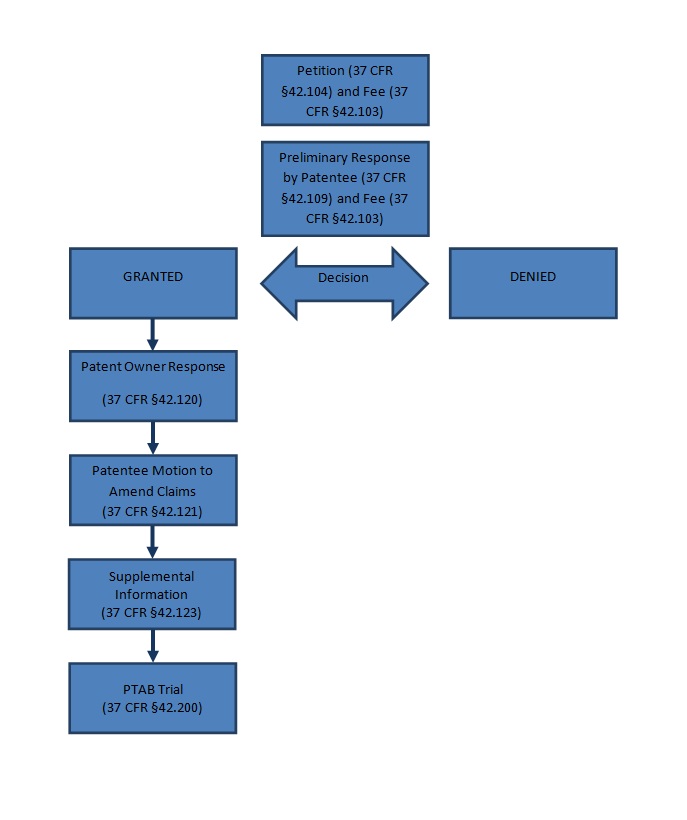
Here is a high level of Inter Partes Review:
Map of Post Grant Review
Here is a high level map of Post-Grant Review procedure:

Post-Grant Review Under the AIA
Background
Post-Grant Review is a trial before the PTAB subject to the procedures set forth in subpart A. Proposed 37 CFR §42.200(a). The Post-Grant Review should be concluded within one year, but this can be extended up to six months, by the Chief Judge of the PTAB. Proposed 37 CFR §42.200(c).
Any person other than the patent owner may petition for a Post-Grant Review, provided that the Petition has not previously challenged the patent in a civil action (Proposed 37 CFR §42.201(a)) and the petitioner is not otherwise estopped (Proposed 37 CFR §42.201(b)). (The regulation is worded to permit simultaneous of subsequent civil action).
A petition for a Post-Grant Review of a patent must be filed no later than the date that is nine months after the date of the grant of an original or reissue patent. (Proposed 37 CFR §42.202(a)). However, Post-Grant Review on a reissue patent must be filed within nine months of the issue of the original patent, except as to claims broadened in a broadening reissue. Proposed 37 CFR §42.202(a)). For at least the first four years, the Director may impose limits on the number of Post-Grant Reviews. (Proposed 37 CFR §42.202(b)).
Initiation
The petition for Post-Grant Review must contain:
A certification that the patent for which review is sought is available for Post-Grant Review (i.e., a patent issuing on an application that ever claimed subject matter filed on or after March 16, 2012) and that the petitioner is not barred or estopped from requesting a Post-Grant Review of the patent. (Proposed 37 CFR §42.204(a)).
A statement of the relief requested, identifying
- the claim (Proposed 37 CFR §42.204(b)(1)).
- the statutory grounds for the challenge, which is restricted to those listed in 35 U.S.C. 282(b) (2) and (3). (Proposed 37 CFR §42.204(b)(2)).
- a statement of how the claim is to be construed. (Proposed 37 CFR §42.204(b)(3)).
- a statement of how the construed claim is unpatentable under the asserted statutory grounds. (Proposed 37 CFR §42.204(b)(4)).
- The exhibit number of the supporting evidence, and a statement of the relevance of the evidence to the challenge raised identifying the specific portions of the evidence that support the challenge. (Proposed 37 CFR §42.204(b)(5)).
Where the grounds for unpatentability is based on prior art, the petition must specify where each element of the claim is found in the prior art. For all other grounds of unpatentability, the petition must identify the specific part of the claim that fails to comply with the statutory grounds raised and state how the identified subject matter fails to comply with the statute. (Proposed 37 CFR §42.204(b)(4)).
The petitioner may correct clerical or typographical errors in the petition by motion to the PTAB. (Proposed 37 CFR §42.204(c)).
The petition and fee (proposed 37 CFR §42.203) must be filed with the PTO, and a copy of the petition and exhibits served upon the patent owner (proposed 37 CFR §42.205)). (Proposed 37 CFR §42.206)).The proposed fees are:
$35,800 for 1-20 claims
$44,750 for 21- 30 claims
$53,700 for 31-40 claims
$71,600 for 41 to 50 claims
$89,500 for 51 to 60 claims
$35,800 for each additional group of ten claims
(Proposed 37 CFR §42.15(b)(1-6)). If the Petition is incomplete it will not be assigned a filing date, and the petitioner has until the earlier of one month or the nine months from issuance to correct the deficiency. (Proposed 37 CFR §42.206(b)). This response must comply with proposed Rule 42.24.
Patentee’s Response to Petition
The patentee has the option to file a preliminary response to explain why no Post-Grant Review should be instituted. (Proposed 37 CFR §42.207(a)). This response must comply with proposed 37 CFR §42.24, and it cannot include new testimonial evidence (proposed 37 CFR §42.207(b)) nor can the patentee amend the claims (proposed 37 CFR §42.207(d)), but the patentee can disclaim patent claims (proposed 37 CFR §42.207(e)). The response is due two months from the date of the petition, but the patentee can speed up the process by filing soon, or waiving the right to a response. (Proposed 37 CFR §42.207(b)).
Instituting Post-Grant Review
If the PTAB decides that the petition would, if unrebutted, demonstrate that it is more likely than not that at least one of the challenged claims is unpatentable, then the PTAB should grant Post-Grant Review. (Proposed 37 CFR §42.208(d)). The PTAB may authorize the review to proceed on all or some of the challenged claims and on all or some of the grounds of unpatentability asserted for each claim. (Proposed 37 CFR §42.208(a)). Similarly, the PTAB can deny some or all grounds for unpatentability for some or all of the challenged claims. (Proposed 37 CFR §42.208(b)).
Conduct of Post-Grant Review
Once the Post-Grant Review is instituted, the patentee may file a response to the petition addressing any ground for unpatentability not already denied (Proposed 37 CFR §42.220(a)) by the date provided by the PTAB, or if none within two months from the date Post-Grant Review is instituted. After conferring with the PTAB, the patentee may make one motion to amend the claims. (Proposed 37 CFR §42.221(a)). This motion must identify the support in the original disclosure of the patent for each claim that is added or amended (proposed 37 CFR §42.221(b)(1)) and the support in an earlier filed disclosure for each claim for which benefit of the earlier filing date is sought (Proposed 37 CFR §42.221(b)(2)). The patentee cannot make amendments that do not respond to a ground of unpatentability involved in the proceeding (proposed 37 CFR §42.221(c)(1)), or which enlarge the scope of the claims or introduce new matter (proposed 37 CFR §42.221(c)(2)).
During the preceding the claims are given their broadest reasonable construction in light of the specification. (Proposed 37 CFR §42.201(c)). Within one month from when a trial has been instituted, a petitioner may request authorization to file a motion identifying supplemental information relevant to a ground for which the trial has been instituted. (Proposed 37 CFR §42.223. In addition to the standard discovery available under the trial regulations, requests for additional discovery may be granted for good cause (proposed 37 CFR §42.224(a)) but is limited to evidence directly related to factual assertions advanced by either party in the proceeding (proposed 37 CFR §42.224(b)).